

Sustainable jewelry pouches are not defined by one fabric or one label. For a jewelry brand, a credible sourcing decision connects the material, pouch construction, expected reuse, manufacturing evidence and the claim eventually shown to the customer. A cotton pouch is not automatically low impact, and a recycled fabric claim is only as useful as the documentation behind it.
This guide explains how B2B buyers can source sustainable jewelry pouches without treating “eco-friendly” as a design style. It focuses on the questions that belong in an RFQ, the evidence to request from a supplier and the trade-offs to approve before bulk production.
What Makes a Jewelry Pouch More Sustainable?
A pouch can improve its environmental profile in several ways. It may use verified recycled or organic fiber, reduce material weight, replace a disposable packaging component, remain useful for storage, or simplify the total packaging system. These routes are not interchangeable. A reusable pouch made from conventional fabric and a lightweight pouch made from certified recycled fiber solve different problems.
Start by defining the outcome your brand wants to support:
- verified material content: a documented percentage of recycled or organic fiber;
- lower material use: fewer layers, smaller dimensions or no unnecessary secondary bag;
- longer useful life: construction suitable for jewelry storage or travel after purchase;
- simpler disposal: fewer mixed components and clear local disposal guidance;
- lower operational waste: a stable design that reduces rejects, obsolete stock and repacking.
A useful brief chooses one or two measurable priorities. Asking for a pouch that is recycled, organic, plastic-free, biodegradable, luxurious, washable, colorfast and inexpensive can create contradictory requirements.

Sustainable Jewelry Pouches sample
Sustainable Jewelry Pouch Options at a Glance
| Option | Potential benefit | What the buyer should verify | Common trade-off |
|---|---|---|---|
| Recycled polyester or microfiber | Uses recycled feedstock and can provide a consistent, durable surface | Recycled-content percentage, scope of certification and transaction documentation | Still a synthetic textile; trims and coatings may complicate end-of-life claims |
| Organic cotton | Supports a defined organic-fiber sourcing route | Fiber composition, certification scope, dyeing and finishing requirements | Heavier fabric or complex construction may increase material and shipping weight |
| Conventional cotton or linen-look fabric | Natural appearance and good compatibility with simple printing | Actual fiber composition, fabric weight, shrinkage and colorfastness | “Natural” alone does not prove a lower-impact supply chain |
| Reusable velvet or suede-like pouch | Premium presentation can encourage continued storage use | Abrasion resistance, shedding, closure life and realistic reuse purpose | Fiber content and backing may be mixed or difficult to separate |
| Reduced-material pouch | Uses less fabric, lining, hardware or individual wrapping | Product protection, usable internal space and damage rate | Removing too much protection can increase returns or replacement shipments |
Use this table to create a shortlist, then compare the tactile, branding and production implications in Packgenio’s jewelry pouch materials guide.
Separate Material Facts From Marketing Language
Terms such as “green,” “earth-friendly” and “sustainable” do not tell a factory what to purchase or a customer what has changed. Convert each broad statement into a specification and a verification request.
For example, “recycled velvet” should become a defined fiber composition, recycled-content percentage, fabric code, color, weight or thickness, backing, lining and certification requirement. “Organic cotton pouch” should state whether the claim applies to the fiber, fabric, finished pouch or an independently certified supply chain.
The Recycled Claim Standard and Global Recycled Standard provide recognized frameworks for recycled-content verification and chain of custody. The Global Organic Textile Standard covers processing requirements for certified organic textiles. These standards are not interchangeable, and a certificate should be checked for holder, scope, product category, validity and issuing certification body.
Do not assume that a certificate shown for one fabric automatically authorizes a claim on every finished pouch. Ask the supplier to explain which entity is certified, which material is covered and what documentation can accompany the specific order. If the brand needs to use a certification mark, confirm the program’s labeling and logo rules before artwork approval.
Design for Use, Not Only for a Sustainability Story
A pouch that remains useful after unboxing can replace a short-lived wrapper, but reuse must be designed into the product. The customer needs a clear reason to keep it: storing earrings separately, protecting a pendant, organizing a travel set or returning jewelry for service.
Check the following during development:
- Is the pouch correctly sized for the jewelry rather than oversized for visual impact?
- Does the closure still work after repeated opening?
- Can chains, posts or clasps catch on seams, drawstrings or hardware?
- Does the fabric shed fibers or transfer color?
- Can the customer identify the pouch’s intended reuse without extra instructions?
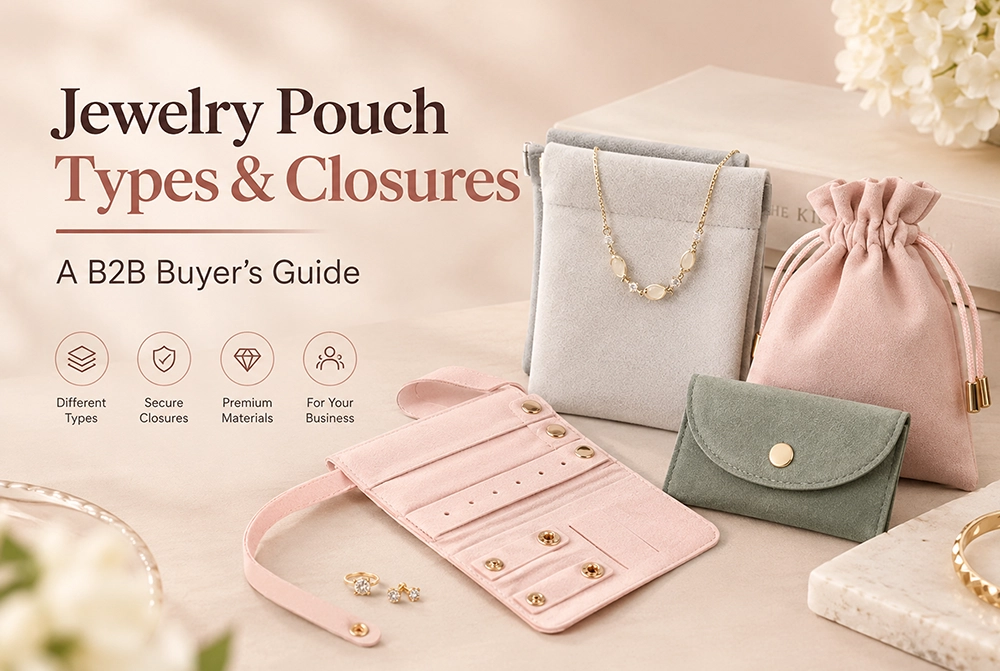
The right structure matters as much as the material. Compare drawstring, flap, snap, zipper and insert-based formats in the jewelry pouch types guide. Then use the jewelry pouch size guide to reduce excess fabric while retaining a practical opening and enough clearance for the product.
Review Every Component, Not Only the Main Fabric
The body fabric may dominate the material weight, but the finished pouch can also include lining, interfacing, foam, ribbon, cord, zipper tape, metal tips, snaps, magnets, labels, thread, ink, foil, adhesive and individual packing. These components affect performance and the accuracy of a broad material claim.
Create a simple bill of materials for the approved sample. Identify which parts are required for function, which are decorative and which could be simplified. A single-material pouch is not always possible, but unnecessary layers and hardware can often be removed before sampling.
Logo choices also matter. A small one-color screen print may use fewer components than an applied badge, while embroidery can support durability but adds thread and stitching. Foil can create a premium appearance but should be tested for adhesion and abrasion on the selected fabric. Packgenio’s custom jewelry pouches with logo guide explains how to match the branding method to the surface instead of choosing it in isolation.
Test Protection Before Removing Packaging
Reducing material is useful only when the jewelry still reaches the customer in acceptable condition. A pouch is usually one part of a packaging system, not a complete shipping package. Fine chains may need controlled positioning. Earring posts need clearance. Polished metal can require separation from hard components, and delicate finishes may react to moisture, residue or dye transfer.
Test the production-intent pouch with the actual jewelry, display card, insert, box and shipping configuration. Review:
- product fit and movement;
- abrasion or pressure points;
- tangling and component contact;
- color transfer under expected moisture and rubbing conditions;
- closure security during handling;
- appearance after simulated packing and transport.
If a lighter pouch produces more damaged products, replacements and customer returns, the total result can be worse than retaining a small protective component. Record the test method and approval criteria rather than relying on an attractive sample photograph.
Control Environmental Claims
Claims shown on product pages, swing tags and packaging should be specific enough to understand and support. “Pouch fabric contains 80% recycled polyester” is more precise than “planet-friendly pouch.” “Designed for jewelry storage after purchase” describes an intended use; it does not guarantee that every customer will reuse it.
The U.S. Federal Trade Commission’s Green Guides explain why broad, unqualified environmental claims can be misleading. Other markets have their own requirements. Brands should have qualified legal or compliance teams review final claims for the countries where the product will be sold.
Keep a claim file with the approved wording, supplier declarations, certificates, transaction documents, test reports, composition records and artwork version. Set an expiry or review date. A statement that was supported for one order should not automatically carry into a reorder if the material source changes.
MOQ, Cost and Production Planning
Sustainable-material projects can carry additional constraints. Certified fabric may have a minimum purchase quantity, a limited color range or a longer replenishment time. Custom dyeing can introduce a separate material MOQ. Multiple pouch colors can split an otherwise efficient volume into small production lots.
Ask the supplier to separate the cost effects of material, certification documentation, dyeing, logo setup, pouch construction and packing. This makes it easier to compare alternatives without removing the feature that matters most. Packgenio’s custom jewelry pouch MOQ guide explains why size, color and logo method often determine the practical minimum for each variation.
For an initial program, a brand may reduce risk by selecting an available certified fabric and color, one proven pouch structure, a simple logo and a limited size range. After demand is known, later orders can add custom colors or more complex components.
What to Include in a Sustainable Jewelry Pouch RFQ
- target use, jewelry type and sales channel;
- finished size, closure and required usable opening;
- fiber composition and minimum verified content percentage;
- applicable standard or certification and required order documents;
- fabric weight, surface, backing, lining and color reference;
- logo method, size, location and approved artwork;
- trim, label and individual-packing requirements;
- quantity by size, color and logo version;
- sample tests and acceptance criteria;
- approved customer-facing claim and evidence-retention requirement.
Send the same specification to every shortlisted supplier. A quotation based only on “eco-friendly pouch with logo” cannot be compared fairly because each supplier may assume a different fiber, weight, certification level and construction.
FAQ About Sustainable Jewelry Pouches
Are cotton jewelry pouches always sustainable?
No. Cotton describes a fiber, not the complete environmental performance of a pouch. Buyers should verify fiber source, fabric weight, dyeing and finishing, construction, expected use and supporting documentation.
Is recycled polyester suitable for premium jewelry pouches?
It can be. Surface quality, density, backing, color and construction determine the final appearance. Approve a physical sample and verify the recycled-content claim separately.
Can a jewelry pouch be called biodegradable?
Only when the claim is appropriately qualified and supported for the finished product under defined conditions. Thread, coatings, inks, labels, closures and mixed fibers may change the result. Avoid making the claim from the body fabric alone.
Does a reusable pouch need a certification?
Reuse is primarily a design and durability proposition, while material certifications address specific sourcing or processing requirements. A brand should describe the intended reuse accurately and retain testing or construction evidence where relevant.
How can a small jewelry brand start with a lower-risk option?
Use an available material and color, keep the structure simple, limit the number of sizes and choose one logo method. Confirm the exact claim and documentation before placing the bulk order.
Build a Verifiable Pouch Specification
The strongest sustainable jewelry pouch program does not begin with a vague label. It begins with a measurable priority, a controlled specification and evidence that follows the material through the relevant supply chain. Product fit, protection and production consistency still matter; sustainability does not excuse a pouch that fails in use.
Packgenio can help jewelry brands compare pouch materials, structures, logo methods and sample requirements for custom production. Share the jewelry dimensions, target quantity, brand standard and the specific material claim you need so the development discussion starts with verifiable requirements.