
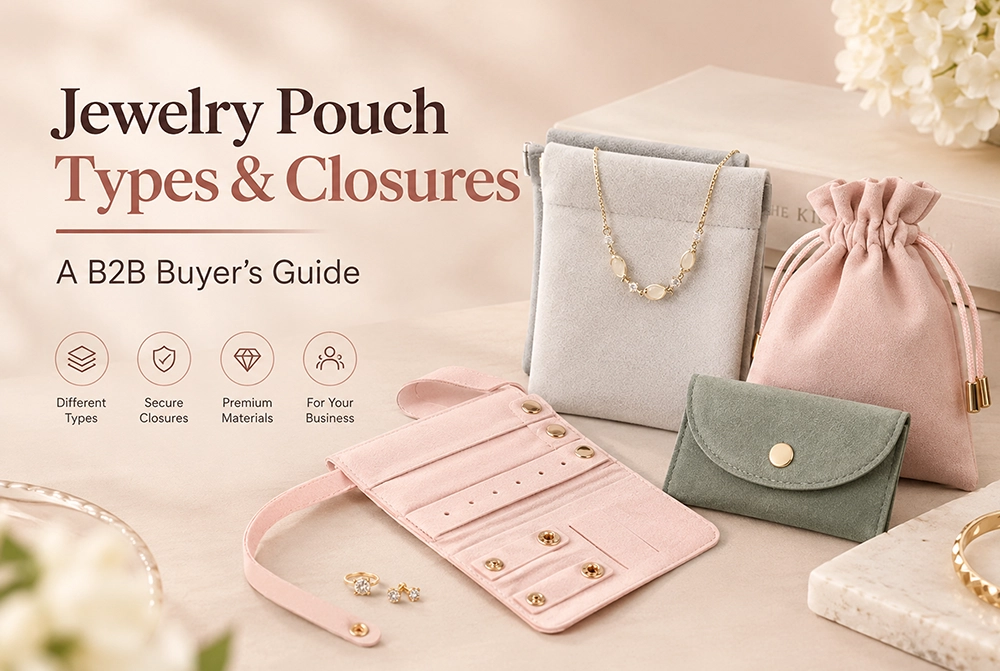
A jewelry pouch is often described by its fabric, but the structure and closure usually determine how it works in daily use. Two pouches made from the same microfiber can behave very differently when one uses a drawstring and the other uses a flap, snap or zipper. The opening changes packing speed. The closure changes security. The shape changes the usable logo area and the way the jewelry sits when the customer opens it.
For jewelry brands, designers, retailers and private-label buyers, choosing among jewelry pouch types should therefore be a functional decision before it becomes a styling decision. The right format must fit the product, support the intended presentation and remain practical to manufacture at the required quantity.
This guide compares the main custom jewelry pouch styles used in B2B packaging programs. It focuses on construction, closure and purchasing considerations. For a separate comparison of velvet, suede, microfiber, satin and cotton, use Packgenio’s jewelry pouch materials guide.
Jewelry Pouch Types at a Glance
| Pouch type | Main advantage | Common concern | Often considered for |
|---|---|---|---|
| Drawstring pouch | Flexible, familiar and easy to produce in many sizes | The gathered top reduces the usable opening and logo area | Rings, earrings, pendants, bracelets and gifting |
| Envelope or flap pouch | Flat profile with a controlled front presentation | The flap needs enough overlap to stay closed | Cards, earrings, fine chains and compact retail packaging |
| Snap-button pouch | Clear opening and closing action | Hardware position and backing can contact the jewelry | Rings, earrings, pendants and reusable presentation pouches |
| Tuck-in or band-closure pouch | Minimal appearance without exposed metal hardware | Closure friction and fit must remain consistent | Modern branded packaging and flat jewelry cards |
| Spring-closure pouch | Fast one-handed access and a clean top edge | The internal spring component adds structure and cost | Retail counters, small premium items and reusable storage |
| Zipper pouch | Secure closure and strong reuse value | Zipper teeth, pullers and internal edges need clearance | Travel-oriented packaging, sets and higher-value accessories |
| Insert-based or divided pouch | Controls product position and separates components | More parts, assembly steps and approval points | Necklaces, earrings, sets and products that must not touch |
These are starting points, not performance guarantees. Test a production-intent sample with the actual jewelry.
Drawstring Jewelry Pouches
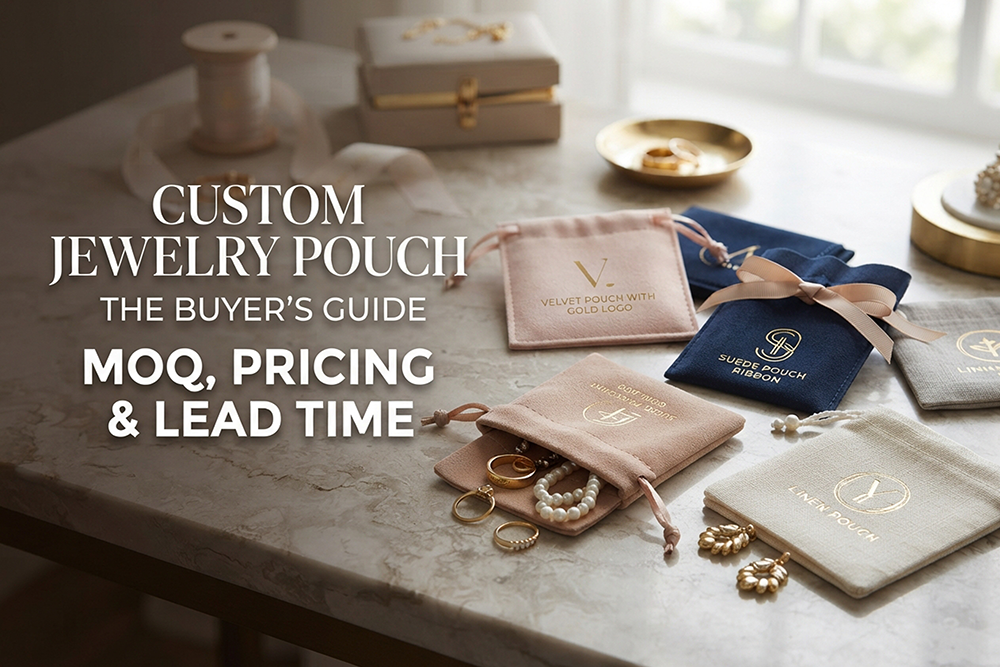
The drawstring pouch is the most recognizable format. One or two cords pass through a channel near the top and gather the fabric when pulled. The shape can be rectangular, square, rounded or gusseted, and the top can finish flush or extend above the channel as a decorative flounce.
Drawstring pouches are useful when a brand wants a flexible format that can cover several jewelry categories. They pack flat before use, accommodate moderate product variation and can be developed in many fabrics. They are also familiar to fulfillment staff and customers, which reduces the need for special opening instructions.
The main design constraint is the gathered area. The nominal width does not equal the usable opening, especially with thick fabric, lining or a wide cord channel. The brand mark should sit far enough below the channel that it remains legible after closing. Cord ends, knots and metal tips should be checked for surface contact with the jewelry and with any rigid box around the pouch.
Drawstrings are not automatically universal: chains can tangle and small rings can disappear inside excess space. Use the jewelry pouch size guide to establish a sampling range, then test the usable opening and packed shape.
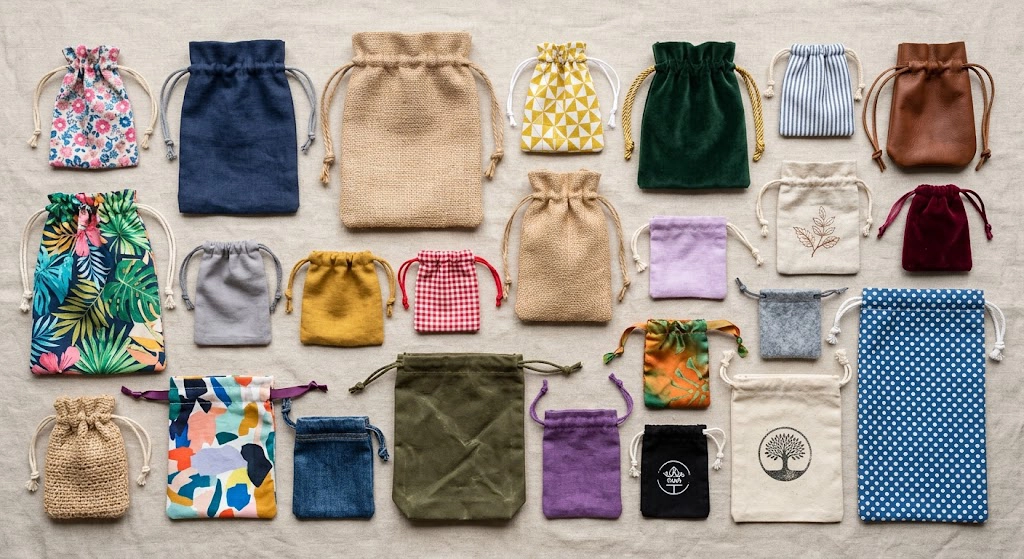
different jewelry pouch with string
Envelope and Flap Jewelry Pouches
An envelope pouch folds a flap over a flat body. The flap may remain unfastened or use a snap, elastic band, ribbon, tuck-in tab or concealed magnet. Because the front face stays relatively flat, the format can create a controlled area for a logo and can fit neatly inside a shallow presentation box.
This structure often works well with jewelry cards, small earrings, pendants and chains that have already been secured. It can also feel more architectural than a gathered drawstring pouch, which suits brands using clean lines and compact packaging systems.
The flap must be evaluated in the filled condition. A design that closes neatly when empty may lift when a card, pad or raised stone is inserted. Confirm the overlap, fold position and product thickness together. If the flap relies only on friction, handle the sample repeatedly to see whether the closure becomes loose. If it uses hardware, inspect the reverse side and any reinforcement so that a hard component cannot rub against the jewelry.
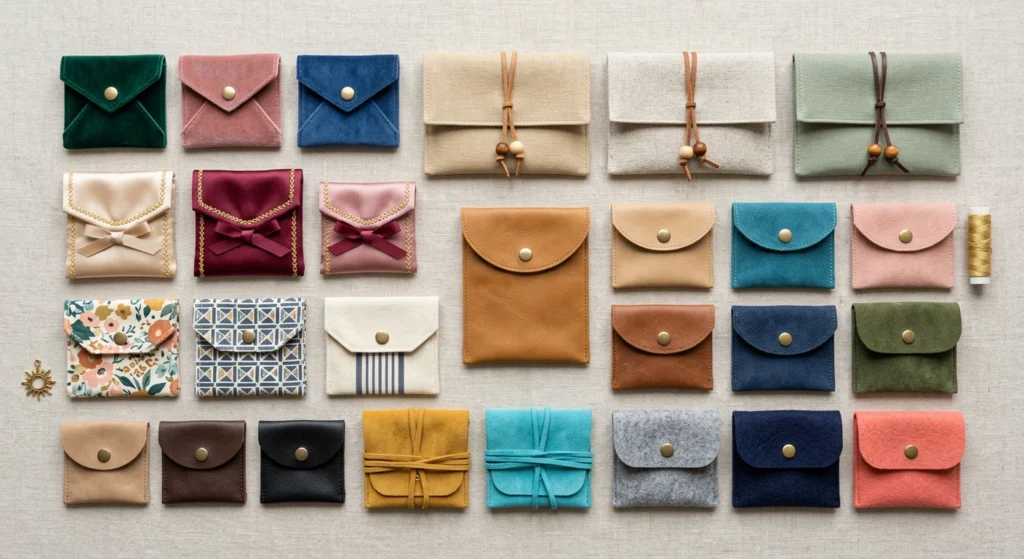
Envelope and Flap Jewelry Pouches
Snap-Button Jewelry Pouches
A snap provides a clear closed position and can make a soft pouch feel more structured. It is commonly paired with an envelope or rounded flap. Snaps can be exposed as a design detail or concealed between layers for a quieter appearance.
The buyer should specify the snap material, color, diameter, location and attachment method. The pouch needs reinforcement around the hardware so that repeated opening does not distort or tear the fabric. Opening force also matters: a closure that is too weak may release during handling, while one that is too strong can make a small pouch difficult to open without pulling the seams.
Test the pouch with the jewelry positioned exactly as it will be packed. A snap cap or backing placed over a stone, post or chain can create a pressure point. The product should have clearance from both sides of the fastener, including when the pouch is squeezed inside an outer package.
Envelope and Flap Jewelry Pouches
Tuck-In and Band Closures
A tuck-in flap slides beneath a band or into a slot. This removes exposed metal components and creates a clean front surface. It can work well for slim jewelry cards and minimalist packaging, provided the flap length and friction are controlled.
The supplier should confirm how the slot or band is formed, whether the edge can fray and how much variation is acceptable. Small changes in fabric thickness can affect closure tension. Approve the design in the final material rather than relying on a paper mockup.
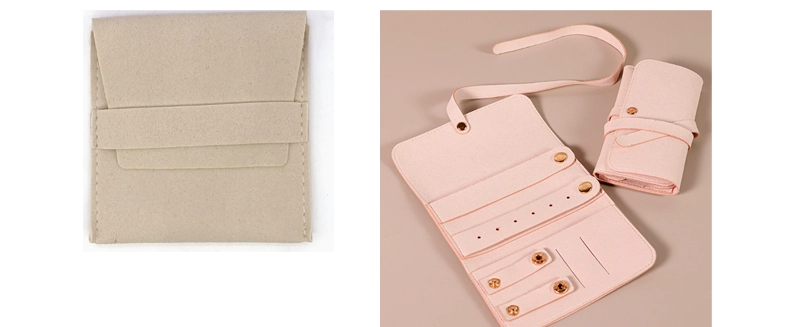
Tuck-In and Band Closures jewelry pouch
Spring Closures
A spring-closure pouch uses a flexible internal frame at the opening. Pressing the sides opens the pouch, while releasing them closes it. The format can be fast to use at a retail counter and offers a tidy top edge without loose cords.
The internal component must be centered, covered and compatible with the intended use. Check opening force, edge padding, noise, corrosion resistance and repeated cycling. The extra component also changes the pouch’s packing density and should be included in the quotation and quality specification.
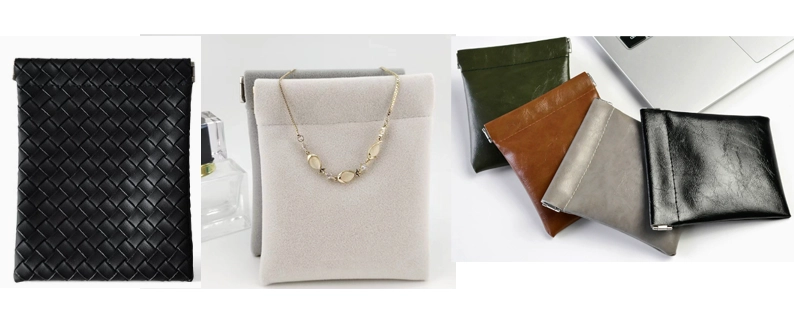
Spring Closures jewelry pouch
Zipper Jewelry Pouches
Zipper pouches provide a secure closure and often have strong reuse value. They can support travel-oriented packaging, jewelry sets or a premium accessory that the customer is expected to keep. A gusset, lining, divider or small internal pocket can be added when the program requires more organization.
The zipper is also a system of components: tape, teeth or coil, slider, puller, end stops and stitching. Specify their color and finish, then test whether any hard edge can touch the jewelry. Fine chains and earring hooks should not enter the zipper path. A protective internal lip or sufficient clearance may be necessary.
Because a zipper adds parts and sewing operations, compare it on total function rather than appearance alone. It may be justified for a reusable travel pouch but unnecessarily complex for a single low-risk item already protected by a box. Inspect the zipper after repeated opening and closing, not only when the sample is new.
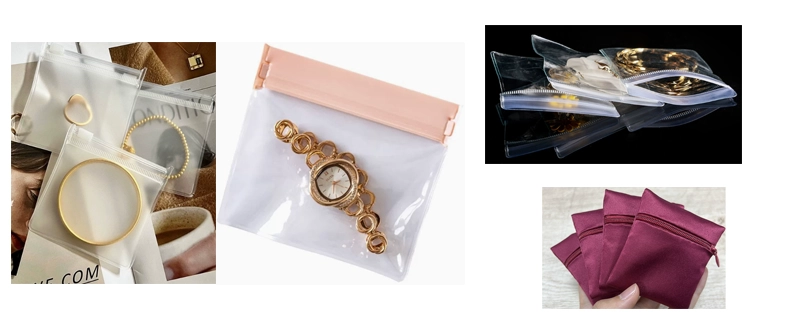
Different Zipper Jewelry Pouches
Insert-Based and Divided Jewelry Pouches
An insert-based pouch combines a soft exterior with a card, pad, tab, hook or shaped support that controls the jewelry. A divided pouch separates multiple items so that they do not rub or tangle. These structures can solve product-retention problems that a larger empty pouch cannot.
For necklaces, an insert can hold the pendant and secure the chain. For earrings, a card can maintain the pair and protect posts. For sets, separate pockets can prevent metal-to-metal contact. The insert should be removable only when that behavior is intentional; otherwise, movement between the insert and pouch can undermine the presentation.
Every additional part creates another specification and inspection point. Record the insert material, dimensions, slot or hole positions, orientation and assembly method. Test the complete set with the smallest and largest intended SKU. If product-contact safety or long-term storage is important, use chemically stable materials and request evidence for relevant claims. The Canadian Conservation Institute’s guidance on storage of metals explains why clean, stable storage materials matter.
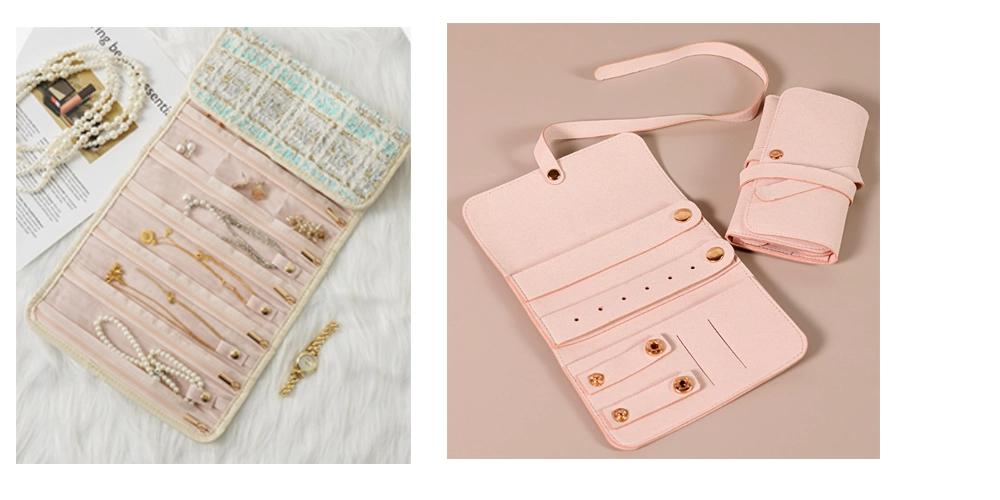
Insert-Based and Divided Jewelry Pouches
How to Match a Pouch Style to the Jewelry and Sales Channel
Start with the packed product and operating workflow. A pouch style should solve a real requirement rather than add a decorative feature that complicates production.
- Rings and studs: compact envelope, snap or insert-based pouches can provide a controlled presentation.
- Fine chains: use a card, tab or divided structure to manage movement; do not rely on empty volume.
- Bracelets and rigid pieces: confirm opening width and the pressure created by any closure hardware.
- Gift-led collections: a drawstring or flounced-top pouch can create a familiar reveal without a complex mechanism.
- Travel or reuse programs: a zipper or divided pouch may justify its extra components and production steps.
- Fast fulfillment: measure how long staff need to insert, close and remove the item without forcing the product.
Also consider the outer package. A large puller, thick knot or spring frame can raise the packed height and change the box or mailer dimensions. Review the pouch as part of the complete packaging set rather than as an isolated item.
Branding Area and Production Implications
Closure style affects the logo even when the material and printing process stay the same. A drawstring creates folds near the top. A flap creates a prominent front panel but may change position when filled. A zipper limits placement near the seam, while a snap requires clearance around the hardware.
Approve the artwork on the final structure at production size. The existing Packgenio guide to custom jewelry pouches with logo compares branding methods in more detail. For the style decision, record the exact logo panel, distance from seams and closure components, viewing direction and acceptable placement tolerance.
Sewn construction should also be specified with more precision than “strong stitching.” ASTM’s D6193 practice for stitches and seams provides standard terminology for sewn items. A buyer does not need to reproduce the standard in an RFQ, but the supplier and inspector should agree on seam type, visible stitch expectations and the defects that cause rejection.
What to Include in a Jewelry Pouch RFQ
Ask suppliers to quote the same specification. At minimum, include:
- Pouch style and closure type.
- Finished outside size and required usable opening.
- Jewelry type, packed dimensions and any product-contact concern.
- Material, lining, reinforcement and insert construction.
- Closure-component material, color and position.
- Logo method, artwork size and placement.
- Quantity by color, size and structure.
- Individual packing, carton and labeling requirements.
- Sample approval and inspection criteria.
Changing the closure can change labor, components, tooling and MOQ. Compare quotations only after confirming that every supplier is pricing the same construction. Packgenio’s custom jewelry pouch MOQ guide explains how specification choices interact with quantity, setup cost and lead time.
FAQ About Jewelry Pouch Types
Which jewelry pouch type is most versatile?
A standard drawstring pouch is flexible across many products and sizes, but versatility does not mean it is ideal for every SKU. Fine chains may need an insert, and compact products may present better in an envelope or snap pouch. Test the actual jewelry and packing workflow.
Is a zipper pouch better than a drawstring pouch?
A zipper provides a more secure closure and often greater reuse value, while a drawstring usually packs flatter and uses fewer components. The better choice depends on product risk, customer use, target cost and whether the pouch must fit inside another package.
Can a snap damage jewelry?
It can create a pressure or contact point if the backing is not covered or if the jewelry sits directly beneath it. Review the internal construction and test the filled pouch under realistic handling and compression.
Do divided pouches prevent necklaces from tangling?
They can reduce contact between items, but the chain still needs controlled placement. A card, hook, tab or pocket designed around the necklace is more reliable than a large undivided space.
Should one pouch style be used across an entire collection?
A shared style can strengthen brand consistency and simplify purchasing, but different sizes or inserts may still be necessary. Use a small style system and document the exceptions rather than forcing very different jewelry into one construction.
Choosing the Right Jewelry Pouch Structure
The right jewelry pouch holds the product, supports the opening experience and remains repeatable in production. Drawstring, envelope, snap, tuck-in, spring, zipper and insert-based pouches solve different problems. None is automatically premium or secure without the final material, dimensions and components.
Before approving bulk production, test the complete pouch with the actual jewelry, logo, insert and outer packaging. Record the construction and closure details in the approved specification. Packgenio can develop custom pouch structures alongside materials, sizes and branding methods; share the jewelry dimensions, preferred style, quantity and presentation requirements so the team can recommend a practical sampling route.