
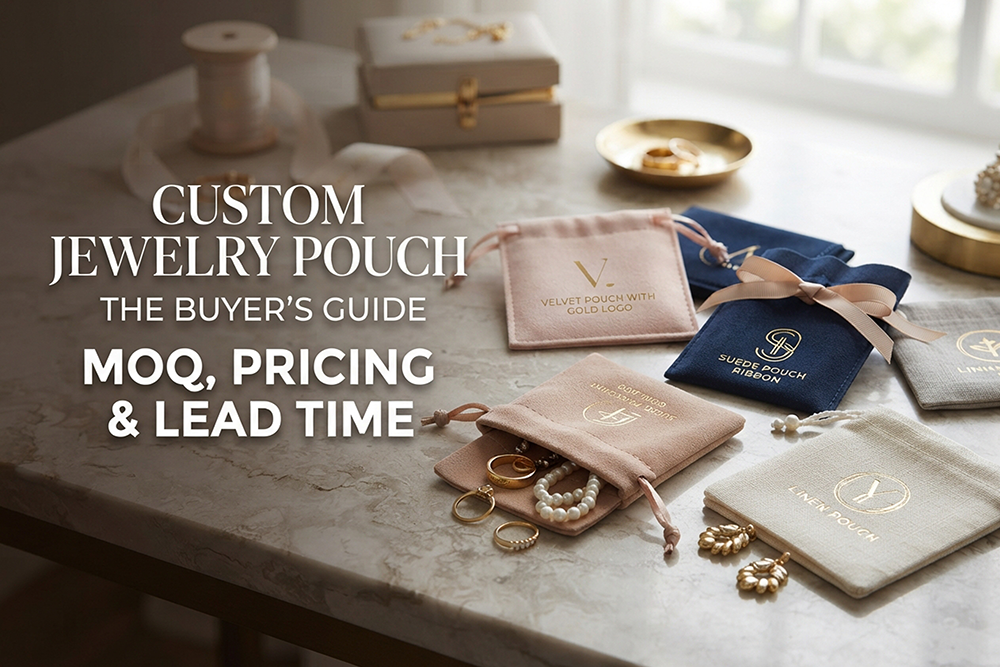
Can you order custom jewelry pouches with a logo in small quantities? In some cases, yes. For an existing pouch size, Packgenio can often discuss logo customization from around 20 pieces, depending on the material, color, size and logo method. The unit price may be slightly higher than for a larger bulk order.
However, 20 pieces is not a universal MOQ for every custom jewelry pouch project. New sizes, special materials, multiple colors or more complex logo processes may require a different quantity. In wider industry practice, MOQ is commonly calculated by one color and one size, but the exact rule must be confirmed for the supplier and specification.
This guide explains how custom jewelry pouch MOQ is calculated, what affects the minimum order quantity, which fees may apply, and how brands can plan a small first order with Packgenio.
What Does Custom Jewelry Pouch MOQ Mean?
MOQ means minimum order quantity. For custom jewelry pouches, the MOQ normally applies to a defined production combination rather than to every pouch a factory makes.
In many projects, that combination is:
- One pouch material
- One pouch color
- One finished size
- One logo design
- One logo application method
For example, 20 black microfiber pouches in one size with one simple printed logo may be treated as one MOQ line. Adding a second color or size may create another quantity requirement, even when the total order remains small.
Always ask how the factory calculates MOQ. A quotation should make clear whether the minimum is based on total pieces, one color and size, each logo version or another production unit.
Can Existing Pouch Sizes Start at Around 20 Pieces?
For an existing jewelry pouch size, around 20 pieces may be enough to add a logo in some Packgenio projects. This is most realistic when the material, color, size and construction are already available and the logo method is relatively simple.
The unit price may be slightly higher at this quantity because setup, artwork preparation, sampling and production handling are spread across fewer pieces. A small MOQ can still be commercially useful for:
- A new brand testing its first packaging batch
- A limited-edition jewelry launch
- A small wholesale collection
- A seasonal gift project
- A brand validating a logo treatment before a larger reorder
Treat this 20-piece starting point as Packgenio project guidance, not an automatic entitlement or a general industry rule. Confirm the exact material, color, size and logo process with the factory before quoting it to a customer.
How MOQ Is Normally Calculated
One Color and One Size
For many custom pouch quotations, MOQ is calculated by one color and one size. This keeps fabric cutting, logo placement and quality inspection consistent. Packgenio should confirm the rule for the exact project.
If a brand requests black, white and pink pouches in the same size, the factory may calculate each color separately. If it requests one color in three different sizes, each size may also be treated as a separate MOQ line.
Ask the factory whether color and size combinations can be combined for the total quantity. Do not assume that 60 total pieces automatically meet a 20-piece minimum for three different colors unless the production team confirms it.
Logo Design and Logo Process
A second logo or a different logo process may create another production combination. A white screen-printed logo and a gold hot-stamped logo are not necessarily interchangeable from a setup or quality-control perspective.
When planning custom jewelry pouches with logo, provide the factory with the final artwork, preferred logo size, logo position and requested material before asking for the minimum.
How Logo Method Changes MOQ
Different logo methods involve different equipment, setup work and production controls. The following pattern is common for custom jewelry pouches, but the exact MOQ should still be confirmed for the selected pouch.
| Logo method | MOQ tendency | Why the quantity may differ | What to confirm |
|---|---|---|---|
| Standard printing | Often supports a smaller run | Simple artwork and familiar setup may be efficient | Surface compatibility, color and print consistency |
| Embossing or debossing | Often supports a smaller run | Suitable simple marks may use a prepared die | Whether the material can hold the relief and die cost |
| Hot stamping | Often supports a smaller run | A simple foil mark may be straightforward after setup | Foil color, heat, pressure, logo size and die cost |
| Embroidery | Often requires a higher MOQ | Thread setup, programming and stitching time add work | Stitch density, backing, detail and minimum quantity |
| Woven or applied label | Varies by label specification | The label can have its own production minimum | Label size, edge, attachment and contact with jewelry |
| Digital or transfer printing | Varies by material and order | Suitable equipment may support detail but require specific media | Color, film feel, adhesion and quantity economics |
In the supplied Packgenio guidance, standard printing, embossing and hot stamping often have lower starting quantities than embroidery. This is a practical pattern, not a fixed threshold for every factory or material. The material, artwork and expected use still determine whether the result is suitable.
Fees That Are Separate From the Pouch MOQ
MOQ is only one part of the quotation. Logo-related setup and development costs are normally calculated separately from the per-piece price.
Ask whether the quotation includes or excludes:
- Logo mold or die fee
- Screen or plate fee
- Embroidery programming fee
- Artwork preparation or file adjustment
- Physical sample fee
- Color matching or special material fee
- Custom hardware or accessory fee
- Individual packaging
- Carton and labeling requirements
- Freight and other delivery charges
For hot stamping or embossing, a logo mold or die may be needed. For screen printing, a screen or plate charge may apply. A physical sample may also be charged separately, even when the final pouch quantity is small.
These charges should be shown as separate line items. Separating them helps the buyer compare two quotations that use different unit prices or setup structures.
How MOQ Affects Cost, Reorders and Timing
Why a Small MOQ Can Have a Higher Unit Price
A 20-piece custom order may carry a slightly higher unit price than a larger order because fixed preparation work is spread across fewer units.
The supplier may still need to complete:
- Material preparation
- Cutting and sewing setup
- Logo artwork review
- Screen, plate, mold or embroidery setup
- Sample development
- Logo alignment and inspection
- Packing preparation
The higher unit price is not necessarily a disadvantage if it allows a brand to test the pouch before committing to a larger inventory position. Compare the complete project cost, including setup fees and shipping, rather than comparing unit prices in isolation.
First Order MOQ vs Reorder MOQ
In normal circumstances, the MOQ for a reorder is the same as the MOQ for the first order. This gives the factory a consistent production reference and avoids treating the same specification as two different quantity rules.
However, a factory may be willing to support a smaller first order when it wants to help a new customer test the market or develop the packaging. This is a negotiation and relationship decision, not an automatic policy.
Ask the factory to confirm:
- First-order MOQ
- Standard reorder MOQ
- Whether a smaller first order is possible as a one-time support arrangement
- Whether the unit price changes at the lower quantity
- Whether the original mold, screen, plate or embroidery program can be reused
- How approved samples and artwork are retained for future orders
- Whether fabric availability or color-lot changes could affect the reorder
Do not promise a permanently reduced MOQ to a customer based only on a one-time first-order arrangement.
Sample and Production Timing
For Packgenio planning, sample development is typically around 5 to 7 days and bulk production is typically around 15 to 25 days after the specification and sample are approved.
These are Packgenio planning ranges, not guaranteed delivery dates. Actual timing can change with:
- Material availability
- Custom color or fabric sourcing
- Logo mold, screen or plate preparation
- Embroidery programming
- Sample revision rounds
- Order quantity
- Number of colors and sizes
- Individual packaging
- Factory production schedule
The production clock should be discussed with the factory after the material, color, size, logo method, artwork and quantity breakdown are confirmed. The buyer should also confirm whether the 15 to 25 days starts after sample approval, after deposit, after artwork approval or after all materials arrive.
How to Reduce MOQ for a First Project
Use an Existing Pouch Size
An existing size generally requires less development than a completely new pattern. Ask which standard sizes are available in the preferred material and color.
Select an Available Material and Color
Stock or regularly produced materials can be easier to arrange for a smaller quantity. Custom dyeing or unusual finishes may introduce additional minimums.
Choose a Simple Logo
One clear logo in a practical size is usually easier to produce than a complex multi-color artwork or a detailed embroidered mark.
Start With One Color and One Size
Because MOQ is normally calculated by one color and one size, limiting variations can make a small first order more feasible.
Compare Logo Processes
If the brand is open to more than one process, ask the factory to compare standard printing, embossing, hot stamping and embroidery for the chosen material. A lower-MOQ method may provide a useful first test while the brand develops a longer-term packaging system.
How to Plan Quantity for a New Brand
MOQ should be compared with the brand’s sales forecast and packaging strategy.
Estimate:
- Current monthly jewelry sales
- Number of active jewelry SKUs
- Number of pouch sizes and colors
- Expected launch or campaign volume
- Reorder timing
- Storage capacity
- Likelihood of changing the logo or packaging design
- Seasonal or gift-period demand
A small first order can reduce the risk of storing packaging that no longer matches the product range. A larger order may lower the unit price when demand and the specification are already stable.
The right choice is not the lowest MOQ in isolation. It is the quantity that gives the brand enough packaging to serve the intended launch while keeping cash and storage risk manageable.
What to Send the Factory for an Accurate MOQ
Send a complete project brief rather than asking only “What is your MOQ?” Include:
- Pouch material preference
- Pouch color or color reference
- Finished size or jewelry dimensions
- Closure and construction
- Lining, insert or card requirements
- Logo artwork
- Preferred logo method, if known
- Logo size and position
- Quantity by color and size
- Individual packaging requirements
- Shipping destination
- Target sample date and launch date
If the logo method is undecided, ask the factory which process is practical for the selected material, color and artwork at the intended quantity. This can reveal a smaller-run option that a generic MOQ request would miss.
For packaging coordination, Packgenio’s custom packaging process can be discussed alongside the available jewelry pouch formats and related jewelry boxes.
MOQ and Sample Approval Checklist
Before placing a bulk order, confirm:
- MOQ per color
- MOQ per size
- MOQ per material
- MOQ per logo design
- MOQ per logo method
- Unit price at the requested quantity
- Logo mold, screen, plate or programming fee
- Sample fee and sample timing
- Material and color availability
- Finished dimensions and usable interior
- Logo size and position
- Sample approval deadline
- Bulk production start point
- Estimated bulk production time
- Packing and shipping requirements
- First-order support, if offered
- Standard reorder MOQ
Approve a physical sample that uses the final material, color, size, closure and logo process. Keep the approved sample and artwork proof as the reference for bulk production and future reorders.
FAQ About Custom Jewelry Pouch MOQ
Can I Order Only 20 Custom Jewelry Pouches With Logo?
In some Packgenio projects, yes. This is most likely when an existing pouch size, available material and relatively simple logo process are used. Packgenio must confirm the exact specification and price before the order is placed.
Is MOQ Calculated by Total Quantity or by Color and Size?
MOQ is normally calculated by one color and one size, although the exact rule can vary by project. Ask whether different colors, sizes or logo versions can be combined to reach a total quantity.
Which Logo Methods Usually Have a Lower MOQ?
According to the supplied Packgenio guidance, standard printing, embossing and hot stamping often support smaller runs than embroidery. The actual MOQ depends on the selected material, artwork, equipment and setup requirements, so it must be confirmed for the exact pouch.
Does the Logo Mold or Screen Fee Count Toward the MOQ?
Usually, logo molds, screens, plates, embroidery programming and physical samples are quoted as separate charges. Ask for these fees as separate line items so you can compare the complete project cost.
Is the Reorder MOQ the Same as the First-Order MOQ?
Normally the MOQ is the same for the first order and reorders. A factory may agree to support a smaller first order for a new customer, but that should be treated as a specific arrangement rather than a permanent reorder rule.
How Long Do Samples and Bulk Production Take?
For Packgenio planning, sample development is typically around 5 to 7 days, while bulk production is typically around 15 to 25 days after the required approvals and production conditions are in place. Confirm the start point and schedule because material sourcing, revisions and packaging requirements can change the timeline.
What Should I Ask Before Requesting a MOQ?
Provide the material, color, size, logo artwork, logo method, quantity by color and size, closure, packaging requirements and shipping destination. The more complete the specification, the more useful the MOQ and price response will be.
How to Choose the Right Custom Jewelry Pouch MOQ
The best custom jewelry pouch MOQ balances a realistic first order with efficient production. Start by checking the available pouch material, color and size, then confirm how the selected logo process affects the minimum and unit price.
Before approving the order, separate logo mold, screen, plate and sample fees from the unit price, confirm whether the reorder MOQ matches the first order, and agree on the sample and bulk-production schedule in writing.
Ready to confirm your minimum quantity and project cost? Share your pouch material, color, size, logo file, quantity breakdown and packaging requirements with Packgenio.