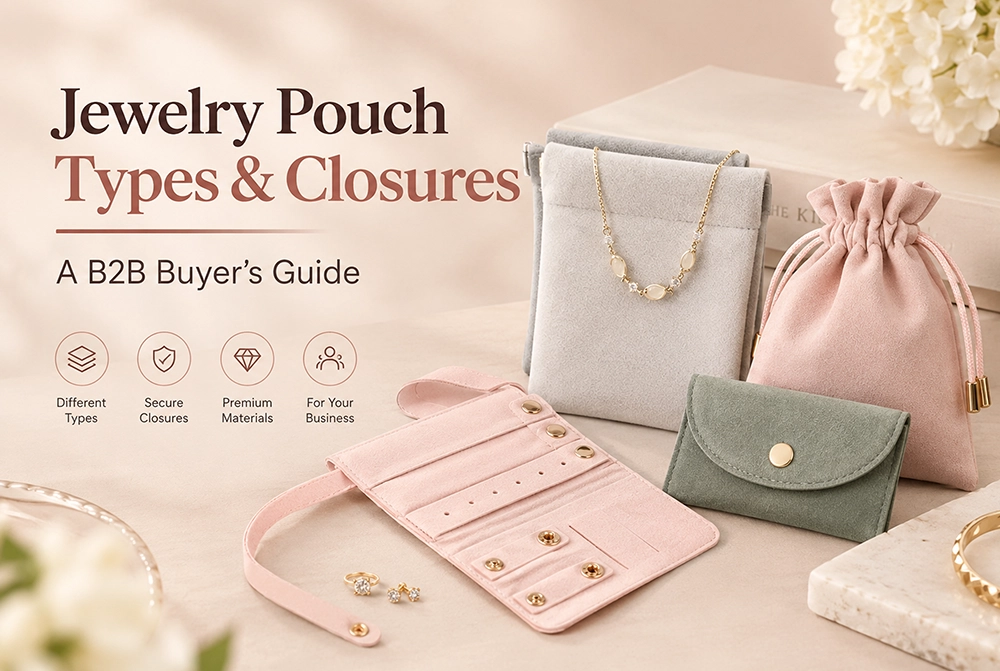


Choosing among velvet, suede, microfiber, satin and cotton is not simply a matter of picking the softest fabric. Each option creates a different visual impression, responds differently to logos and color, and brings its own questions for sampling and bulk production.
There is no single best choice for every brand. Velvet often supports a rich, traditional presentation. Suede or faux suede can create a quieter matte finish. Microfiber is useful when a smooth surface and consistent customization are priorities. Satin offers shine and a gift-focused look, while cotton suits brands that prefer a natural, casual or craft-led presentation.
The right decision depends on the exact material specification, the jewelry being packed, the intended customer experience and the realities of production. This guide compares the five most common jewelry pouch materials and explains what brands should verify before approving a bulk order.
Jewelry Pouch Materials at a Glance
Material names can be misleading if they are used without a technical specification. Velvet and satin describe how a textile looks or is constructed, but they do not identify one fixed fiber. A velvet pouch may use polyester, rayon, cotton or a blend. Satin may be made from silk, polyester or another fiber. Likewise, “suede” may refer to genuine leather suede, synthetic suede or a microfiber-based imitation.
For sourcing purposes, do not approve a pouch based only on a broad trade name. Ask the supplier to state the fiber composition, fabric construction, weight or thickness, color reference, finish and any lining or backing.
| Material | Typical visual character | Often considered for | Main point to test |
|---|---|---|---|
| Velvet | Deep color, soft pile, traditional luxury | Fine jewelry, gifting and premium presentation | Pile consistency, lint, pressure marks and logo clarity |
| Suede or faux suede | Matte, understated and tactile | Minimalist, contemporary or premium collections | Exact composition, color rubbing, abrasion and surface consistency |
| Microfiber | Smooth, soft and controlled | Branded retail pouches, travel pouches and coordinated packaging | Grade, thickness, seam strength, surface wear and logo result |
| Satin | Lustrous, lightweight and decorative | Gifts, bridal jewelry and event packaging | Snagging, wrinkles, seam quality and logo adhesion |
| Cotton | Natural, matte and casual | Artisan, lifestyle and craft-led brands | Shrinkage, dye consistency, wrinkles and print definition |
This comparison describes common design tendencies, not guaranteed performance. Two fabrics sold under the same material name may perform very differently because of fiber composition, density, finishing and production quality.
Comparing the Five Main Jewelry Pouch Materials
Velvet Jewelry Pouches
Velvet is recognizable by its raised pile, which gives the fabric depth and changes its appearance as light moves across the surface. Dark green, burgundy, navy and black velvet are often associated with traditional fine-jewelry presentation, while lighter colors can make the same material feel more contemporary.
Velvet works well when tactile richness is central to the packaging concept. It can make a small pouch feel substantial even before additional components are added. However, pile height and density affect both appearance and production. A thin or uneven pile may reveal pressure marks, while a dense pile can make fine logo details more difficult to reproduce.
Brands should test velvet for loose fibers, dust attraction, surface crushing and color transfer. The drawstring channel and stitched edges also deserve close inspection because the pile can hide inconsistent sewing in photographs. If the pouch will be compressed inside an outer box, test whether the surface recovers after storage.
Logo performance depends on the actual fabric and process. A physical logo sample is essential because a method that looks sharp on a flat woven fabric may lose detail on a raised pile. Packgenio’s velvet jewelry pouch is one example of how shape, closure and branding can be developed together rather than treating the material as an isolated choice.

Custom Velvet Jewelry Pouch With String
Velvet is a strong candidate when the intended look is tactile, formal and gift-ready. It may be less suitable when the packaging must remain extremely flat, resist visible pressure marks or support very small logo details without adaptation.
Suede and Faux Suede Jewelry Pouches
Suede creates a soft, matte surface with less shine than velvet or satin. That restrained appearance can suit modern jewelry collections, neutral color palettes and brands that want premium packaging without a highly decorative finish.
The first sourcing question is what the word “suede” means in the quotation. Genuine suede is leather with a napped surface. Faux suede and microsuede are textile alternatives and may use different fiber blends, backings and finishes. These options are not interchangeable in cost, care, consistency or sourcing documentation.
For genuine suede, brands may need to evaluate natural variation, thickness, odor, color consistency and the relevant leather-processing documentation. For synthetic suede, the focus may shift to abrasion, pilling, backing stability and fiber composition. In either case, test whether rubbing the material against a light-colored cloth transfers dye or surface particles.
Suede-like materials can carry embossed, printed, foil or stitched branding, but the best method depends on surface texture and backing. Fine artwork should be tested at production size. A logo that looks balanced on a digital mockup can become shallow, blurred or uneven when applied to a soft napped surface.

Suede Jewelry Pouch
Suede or faux suede is worth considering for a quiet, tactile and contemporary look. Before comparing prices, make sure every supplier is quoting the same material category and construction.
Microfiber Jewelry Pouches
Microfiber jewelry pouches are often selected for their smooth hand feel, matte appearance and ability to support clean, repeatable shapes. The material can work across entry-premium, contemporary and luxury packaging, depending on its weight, density, finish and construction.
“Microfiber” alone is not a complete specification. Brands should request the fiber composition, thickness or weight, surface finish, backing and color reference. A lightweight promotional-grade fabric and a dense premium microfiber may carry the same general name while looking and performing very differently.
Sampling should cover surface abrasion, pilling, edge fraying, seam strength and drawstring operation. Test the pouch with the actual jewelry, especially when the piece has prongs, sharp findings or textured metal that could catch on the interior. Check both the face and reverse side of any embroidered or applied logo so that hard backing materials do not contact the product.
Microfiber can be particularly useful when a brand needs controlled color, a relatively flat logo area or a pouch that coordinates with a box and bag. Custom microfiber jewelry pouch shows one possible construction, while this pink microfiber pouch illustrates how color and format affect the final presentation.

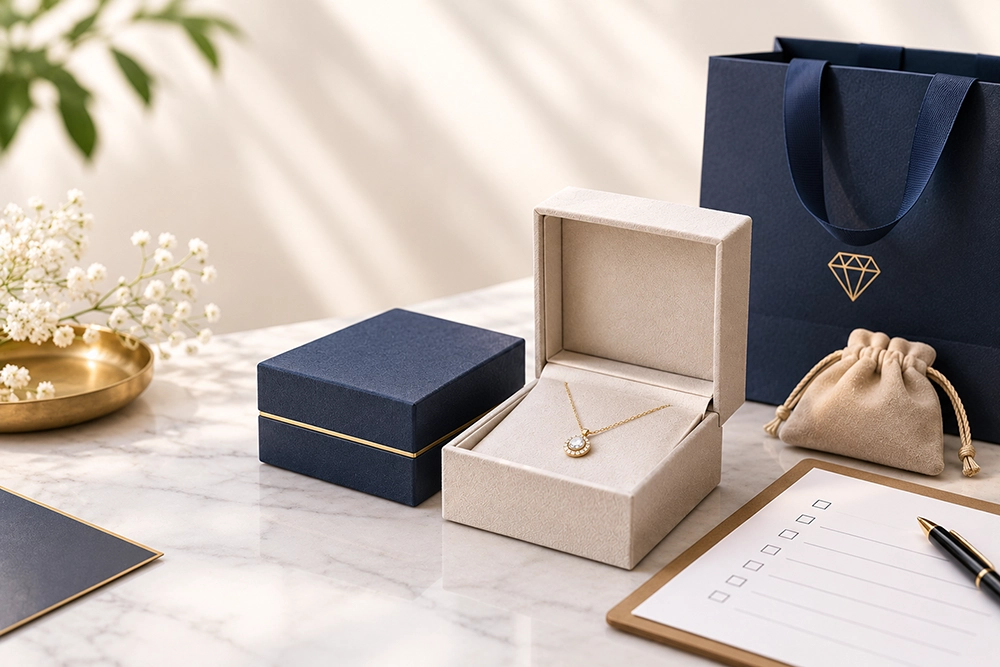
Microfiber jewelry pouch with a box
Microfiber is not automatically anti-tarnish, colorfast or environmentally preferable. Those are separate performance or sourcing claims that require evidence for the specific fabric and finished pouch.
Satin Jewelry Pouches
Satin is valued for its smooth surface and reflective sheen. It can make packaging feel celebratory and is frequently considered for bridal jewelry, gifts, limited editions and event-focused collections.
The term describes a fabric structure and appearance rather than a guaranteed fiber content. Silk satin and polyester satin, for example, have different costs, care requirements and production considerations. A supplier should identify the actual composition rather than listing only “satin” on the specification sheet.
Because satin reflects light, wrinkles, pulls and seam irregularities can be more visible than they are on matte fabrics. Test for snagging around prongs and clasps, examine stitching under direct light and check whether the pouch creases after being packed for shipment. The drawstring should close without bunching the fabric so tightly that it leaves a permanent-looking mark.
Printed or transferred logos can look crisp on a smooth satin surface, but adhesion, heat sensitivity and color contrast must be tested on the selected grade. Metallic artwork may compete visually with the fabric’s shine, so a restrained logo size often produces a more controlled result.

Satin jewelry pouch
A satin jewelry pouch can support a polished gift presentation, but it should not be chosen on appearance alone. Its snag resistance, construction and packing method need to match the product and distribution route.
Cotton Jewelry Pouches
Cotton pouches create a matte, familiar and less formal presentation. Natural, off-white and muted-color cotton can fit artisan jewelry, lifestyle collections, handmade products and brands that prefer a simple visual language. Cotton canvas can feel more structured, while lighter weaves create a softer and more flexible pouch.
Unlike velvet or satin, cotton identifies a fiber, but the finished material still needs a fuller specification. Ask about fiber percentage, weave, fabric weight, dyeing or bleaching, pre-shrinking, coatings and any blended fibers. These details influence texture, print quality, shrinkage and appearance after handling.
Cotton is often compatible with screen printing and woven labels, making it useful for graphic logos and one- or two-color artwork. Print definition still depends on the weave and surface. A coarse canvas may suit a bold mark but lose very fine lines, while a tightly woven cotton may reproduce detail more clearly.
Bulk samples should be checked for shrinkage, wrinkles, loose fibers, drawstring friction and color variation. A cotton canvas jewelry pouch can be a practical reference when evaluating fabric weight, pouch structure and printed branding as one complete specification.

Cotton Mesh Pouch
Cotton should not be described as sustainable, recyclable or compostable without qualification. Dyes, finishes, blended fibers, labels, sewing thread and closures all affect the finished product’s environmental profile and end-of-life options.
Which Jewelry Pouch Material Fits Your Brand?
The material should reinforce the product position rather than follow a generic idea of luxury. Start with the visual and functional job the pouch must perform.
For Traditional Luxury and Gifting
Velvet is often the first material considered when a brand wants depth, softness and a formal presentation. Satin can work when the desired effect is lighter, brighter and more celebratory. The choice between them is less about which is “more luxurious” and more about whether the brand language is tactile and classic or smooth and luminous.
For Modern and Minimalist Jewelry
Faux suede, microsuede and premium microfiber can support a quiet, matte aesthetic. Their relatively restrained surfaces allow jewelry, typography and precise color choices to carry the design. Compare physical swatches under the lighting used in stores and photography; subtle texture differences can be difficult to judge on screen.
For Artisan and Lifestyle Collections
Cotton, especially canvas or a visible woven construction, can feel direct and approachable. It pairs naturally with simple printing, woven labels and unbleached color palettes. Brands should still avoid assuming that a natural-looking surface proves a lower environmental impact.
For E-commerce and Travel
For products shipped directly to customers, construction may matter more than the fabric name. A properly sized pouch with secure closure, sound stitching and an appropriate outer box can outperform a more decorative pouch that allows the item to move freely. When multiple pieces share one pouch, dividers or separate compartments may be necessary to reduce metal-to-metal contact.
Does the Pouch Material Protect the Jewelry?
A soft pouch can help separate jewelry from other objects and reduce ordinary surface contact, but it should not be treated as complete shipping protection. Fabric alone does not prevent crushing, strong impact, moisture exposure or movement inside an oversized package.
Protection depends on the full packaging system:
- Pouch dimensions and how closely they fit the jewelry
- Interior surface and any lining or backing
- Closure design and drawstring hardware
- Separate compartments for chains, earrings or multiple pieces
- The structure and cushioning of the outer jewelry box or mailer
- Storage and shipping conditions
Test necklaces for tangling, earrings for post penetration and rings or stone-set pieces for snagging. If the jewelry has delicate finishes, pearls, porous stones or treated surfaces, confirm material compatibility with a qualified jewelry-care specialist before approval.
No standard velvet, suede, microfiber, satin or cotton pouch should be called anti-tarnish without specific evidence. Silver tarnish is strongly influenced by sulfur-containing gases and the storage environment. The Canadian Conservation Institute’s guidance on the care of silver emphasizes appropriate materials and sealed storage controls rather than relying on a generic soft fabric.
If tarnish resistance is important, ask the supplier to identify the active technology, test method, expected effective period and storage conditions. Also confirm whether the claim applies to the fabric itself, an insert, an interior treatment or the complete finished package.
Logo Methods and Bulk-Order Testing
Material and branding method must be developed together. Screen printing, foil or heat transfer, embossing, embroidery and woven labels can all work in the right construction, but none is universally suitable for every pouch.
Screen printing is often considered for flatter woven surfaces such as cotton and some microfiber grades. Raised piles may require simplified artwork or a different process. Foil and heat-applied methods depend on temperature, pressure and surface chemistry. Embroidery adds texture but also introduces thread, backing and bulk. Woven labels are flexible, although their edges and placement should not rub against the jewelry.
Before placing a bulk order, approve a physical sample that uses the intended production material, color, logo dimensions and closure. A generic stock sample can show workmanship, but it cannot confirm the result of the final combination.
For repeat orders, ask how the supplier controls fabric lots and retains approved color and logo references. A clear sample approval record reduces arguments later because the production team, buyer and quality inspector are comparing the goods against the same standard.
Brands sourcing multiple components can review Packgenio’s jewelry pouch collection and custom packaging process when planning coordinated pouches, boxes and bags.
How to Evaluate Sustainability Claims
Material names are not environmental conclusions. Polyester satin is different from silk satin; genuine suede is different from synthetic microsuede; and a cotton pouch with coatings, mixed-fiber cords and synthetic labels is different from an undyed single-fiber construction.
Ask suppliers for evidence at the level of the exact product and facility. Useful questions include:
- What is the complete fiber composition by weight?
- Is recycled content claimed, and what percentage is it?
- Which component does a certificate cover: fabric, dyeing facility, sewing factory or finished pouch?
- Does the scope and validity period match the current order?
- Are coatings, inks, drawstrings, labels and packing materials included in the claim?
- Is the pouch designed for realistic reuse, and has that use been tested?
- Which local collection or disposal route supports an end-of-life claim?
OEKO-TEX Standard 100 concerns testing textiles for harmful substances. It does not by itself establish recycled content or a lower overall environmental footprint. The Global Recycled Standard addresses recycled materials and chain-of-custody requirements, but buyers still need to verify the certificate holder, scope and product relevance.
Broad terms such as “eco-friendly,” “green” or “sustainable” should not replace specific evidence. The US Federal Trade Commission’s Green Guides summary explains why environmental claims need clear qualification and substantiation.
FAQ About Jewelry Pouch Materials
What Is the Best Material for Jewelry Pouches?
There is no universal best material. Velvet suits a deep, tactile and traditional presentation; suede-like materials and microfiber can support a modern matte look; satin offers luster; and cotton creates a natural, casual appearance. The best choice is the material that passes product-contact, branding, color, construction and shipping tests for the intended use.
Is Velvet or Microfiber Better for Jewelry Pouches?
Velvet generally creates more visual depth because of its pile, while microfiber can provide a smoother and more controlled surface. Velvet may suit formal gifting, whereas microfiber can be easier to adapt across contemporary shapes and branding styles. Compare production samples rather than relying on the name because grade and construction can change the result significantly.
Is Suede the Same as Microfiber?
Not necessarily. Genuine suede is leather. Faux suede or microsuede may be made from synthetic microfiber, but composition and construction vary. A quotation should state whether the material is genuine leather, faux suede or a microfiber textile and provide the relevant specification.
Are Satin Pouches Suitable for Fine Jewelry?
They can be suitable for presentation if the selected fabric and construction pass contact, snagging, seam and fit tests with the actual jewelry. Satin alone does not provide impact or crush protection, so an outer box may still be needed for storage and shipping.
Are Cotton Jewelry Pouches Eco-Friendly?
Cotton may support a natural design direction, but the word “cotton” does not prove that a finished pouch is environmentally preferable. Fiber origin, agricultural and processing practices, dyeing, coatings, accessory materials, durability and realistic disposal routes all matter. Request specific, current documentation for any environmental claim.
Which Jewelry Pouch Material Prevents Tarnish?
None of the five standard materials should automatically be considered anti-tarnish. Tarnish control requires a defined material or treatment, evidence for the claimed performance and suitable storage conditions. Ask what technology is used, which test supports it and how long the effect is expected to last.
Can All Jewelry Pouch Materials Be Customized With a Logo?
Most can be customized, but the appropriate logo method depends on surface texture, heat sensitivity, backing, artwork detail and order requirements. Approve a physical logo sample on the final fabric before bulk production.
Choosing the Right Jewelry Pouch Material
The most effective material is not simply the one that feels softest in a sample book. It is the one that supports the brand’s visual direction, works with the jewelry, reproduces the logo clearly and remains consistent through production, packing and delivery.
Use broad names such as velvet, suede, microfiber, satin and cotton to begin the discussion, then convert the chosen direction into a measurable specification. Confirm composition, construction, color, logo method, dimensions, closure, quality checks and packaging before approving the bulk order.
Packgenio works with jewelry brands to develop custom pouches alongside coordinated jewelry boxes and other packaging components. To discuss a project, share your jewelry dimensions, preferred material, target color, logo artwork, quantity and destination through the contact page.