
Private label jewelry brands often invest significant effort in the first packaging launch and then lose consistency during replenishment. A pouch color shifts slightly between batches. A jewelry card is printed with an old logo. A ring insert is paired with the wrong SKU. A carton arrives without clear marks, so the warehouse spends time opening boxes to identify the contents.
These problems are rarely caused by one bad component. They happen when packaging knowledge lives in scattered emails, unlabelled samples and individual memories. A repeatable private label packaging system turns those decisions into controlled records that the brand, factory and fulfillment team can use together.
This guide explains how to standardize private label jewelry packaging for launch collections and repeat orders. It focuses on the operating details that keep packaging consistent as styles, colors, quantities and sales channels change.
Define what private label packaging includes
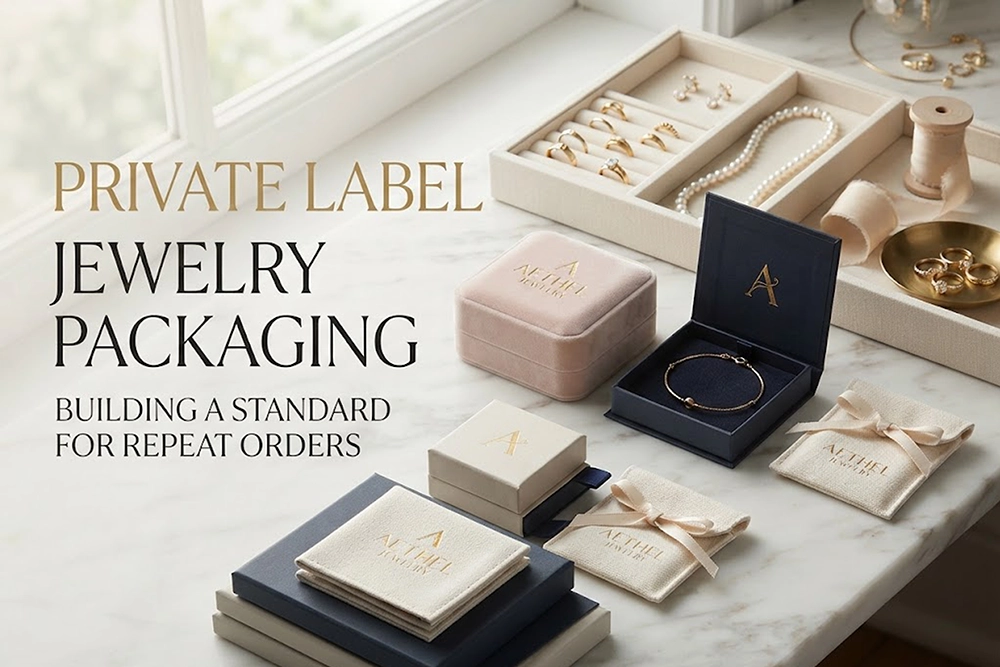
Private label packaging is more than a logo on a pouch. It is the complete set of customer-facing and factory-facing components that identify, protect and prepare a jewelry item for sale.
Typical components include:
| Component | Decisions to standardize |
|---|---|
| Pouch or bag | Material, color, internal size, closure, logo position and finish. |
| Box or tray | Structure, lid clearance, insert, dimensions and opening experience. |
| Jewelry card | Paper, thickness, print colors, hole position, copy and SKU area. |
| Insert | Product retention, material, shape, tolerance and assembly method. |
| Care or authenticity card | Language, legal copy, paper, version number and placement. |
| Label or barcode | Identifier, label size, placement, scan quality and carton rules. |
| Shipping carton | Inner quantity, carton marks, protection and pallet or parcel plan. |
Not every brand needs every component. The important decision is to define the complete pack configuration for each product family and record what is optional, seasonal or channel-specific.
Packgenio’s custom jewelry pouches with logo guide can help teams compare branding methods. A private label system should then document the approved method and the conditions for using it across future orders.
Build a packaging SKU matrix
The most useful control document is a packaging SKU matrix with one row for each jewelry SKU or approved product family. It becomes the bridge between merchandising, packaging production and fulfillment.
At minimum, include:
- Jewelry SKU and product name.
- Jewelry type and size range.
- Pouch, box or card code.
- Insert code and orientation.
- Packaging color and finish.
- Logo artwork version and application method.
- Quantity per retail pack and quantity per master carton.
- Barcode or identifier requirements.
- Packing photograph or assembly reference.
- Approval date and revision number.
If several jewelry styles share the same packaging, list the shared component once and record the exceptions separately. This prevents a common component from being redesigned for one style without checking the other products that depend on it.
Use Packgenio’s jewelry pouch size guide when defining the internal dimensions, but approve the final fit with the actual jewelry and insert. Nominal measurements alone do not show whether a pendant catches, a bracelet shifts or a ring setting touches the lid.
Control artwork and brand assets
Private label orders become difficult to repeat when the factory receives multiple logo files or verbal instructions such as “use the latest gold.” Create one controlled artwork package for each brand and identify it with a file name and version.
The artwork package should state:
- The approved logo file, preferably in a suitable vector format.
- Clear space, minimum size and placement reference.
- Application method, such as hot foil, embossing, screen printing or heat transfer.
- Approved color reference and acceptable visual tolerance.
- Whether the logo is centered, offset, repeated or placed on a specific panel.
- The packaging components to which the artwork applies.
A screen proof on a monitor is not enough for every application. Foil, ink and embossing appear differently on velvet, microfiber, paper and coated board. Approve the mark on the actual material and retain a physical master sample or high-quality reference photograph.
When the brand changes its logo, do not overwrite the old file without a record. Mark the previous version obsolete, define the transition order and state whether old components can be consumed or must be replaced.
Standardize color and material references
Color consistency is a frequent source of disagreement in repeat packaging orders. A fabric pouch, printed card and coated box may not reproduce the same color in the same way. The brand should decide which color is the visual master and how each material will be evaluated.
Record:
- A physical approved sample for each critical component.
- The color reference or target description.
- Material, coating and finish.
- Acceptable variation and who approves it.
- Lighting conditions for visual comparison when relevant.
- Whether the component is dyed, printed, laminated or foil-stamped.
Do not approve a color only from a digital screen. Send a reference sample or approve a production sample made on the intended substrate. Packgenio’s jewelry pouch materials guide is useful for comparing material behavior, but the repeat-order standard must name the selected material and finish precisely.
Match the packaging to the jewelry and channel
Private label packaging should support the product rather than force every product into the same configuration. A fine necklace needs chain control. A heavy bracelet needs a stable base. Stud earrings need a card that holds the posts without bending them. A ring with a tall setting needs lid clearance.
The sales channel also matters. A retail display package may prioritize shelf presentation, while an e-commerce pack needs compact dimensions, a repeatable pick-and-pack process and an outer shipping layer. A wholesale order may require carton labels and inner quantities that are irrelevant to a direct consumer shipment.
Define channel variants explicitly. For example:
| Channel | Packaging control to add |
|---|---|
| Direct-to-consumer | Compact shipper, packing sequence, return or care insert. |
| Wholesale retail | Inner pack quantity, carton marks and store-ready presentation. |
| Marketplace fulfillment | Required identifier, sealed unit, label placement and prep rules. |
| Pop-up or trade show | Easy opening, display arrangement and transport protection. |
Do not create a new component for every channel unless the difference improves operations or customer experience. Shared components reduce inventory complexity and make replenishment easier.
Set up identification and labeling rules
Packaging errors are often identification errors. A barcode, SKU label or carton mark should tell the warehouse what the package contains without requiring someone to open it.
Define which identifiers are needed at each level: individual unit, inner pack and master carton. If the brand sells products through retail or marketplace channels, confirm the applicable identifier requirements before printing. GS1’s standards resources explain the role of standardized product identification and data carriers; the brand and channel should determine the exact implementation.
Keep the barcode area flat, clean and free from foil or texture that reduces scanning. State the label position with a drawing or photograph. For cartons, include SKU, quantity, purchase order, destination and handling marks as required by the receiving operation.
Create a master approval record
Before bulk production, assemble one approval record that represents the complete customer experience. It should contain the jewelry sample, pouch or box, insert, cards, labels and the proposed packing sequence.
The approval record should answer:
- Is the jewelry held securely without rubbing or pressure?
- Is the logo correctly positioned and reproduced on the intended material?
- Are the colors and finishes acceptable under the agreed reference?
- Does the package close, open and stack as intended?
- Are the copy, language, barcode and SKU details correct?
- Can the fulfillment team pack it without improvising?
- Are the outer carton quantity and marks clear?
Sign and date the record. Assign a revision number. Store photographs and measurements with it. A supplier such as Packgenio can use this reference when preparing future samples, but the buyer should retain the final approval as the controlling record.
Manage changes between orders
Reorder consistency does not mean that every future order must remain frozen forever. It means that changes are deliberate, visible and approved.
Use a simple change-control process:
- Describe the requested change and the reason for it.
- Identify all affected packaging SKUs, artwork files and inventory.
- Request a revised sample or proof where the change affects fit, color, logo or copy.
- Record the approval date and new revision number.
- Tell the fulfillment and purchasing teams when the new version becomes active.
Common changes include a new logo, a new product size, a material substitution, a language update or a carton quantity change. A change that looks small on one component may affect labels, inserts, packing time and shipping dimensions elsewhere in the system.
Plan for replenishment and inspection
Before a repeat order enters production, compare the supplier’s quotation and sample against the master record. Confirm the component codes, artwork version, color reference, dimensions, quantity and target delivery date.
At receiving, inspect a meaningful sample of the shipment. Check the areas most likely to drift: logo position, color, closure function, insert fit, card copy, barcode readability and carton marks. Photograph any issue with the relevant SKU and lot information.
Keep a small number of approved master samples in a protected, labelled location. Replace them only through a documented approval. An unlabelled “latest sample” is not a reliable production standard.
FAQ
What is the difference between branded packaging and private label packaging?
Branded packaging may add a logo to an existing component. Private label packaging is a controlled system built around a brand’s product assortment, artwork, packaging components, labeling and repeat-order process. The scope can be small, but the records need to be clear.
How many packaging SKUs should a private label jewelry brand create?
Create only the variants that improve fit, presentation or fulfillment. Shared pouches, cards and boxes can reduce inventory, but forcing very different products into one size may create damage or poor presentation. Use the SKU matrix to make the trade-off visible.
Should the packaging MOQ match the jewelry MOQ?
Not always. Packaging components may be ordered separately, shared across several jewelry SKUs or purchased in a quantity that supports future replenishment. Discuss the relationship between component MOQ, storage capacity and forecast demand before approving a program.
How should a brand approve a repeat-order color?
Compare the production sample with the approved physical reference on the agreed material and under consistent lighting. Record the result and any accepted tolerance. A screen image alone cannot control a fabric dye, print or foil finish reliably.
What should be saved for the next reorder?
Save the packaging SKU matrix, approved master sample photographs, artwork files, component codes, measurements, packing instructions, carton rules and revision history. These records make a future quotation and sample review much faster.
Conclusion
Private label jewelry packaging becomes easier to scale when the brand treats it as an operating system rather than a one-time decoration project. A SKU matrix, controlled artwork package, physical color references, channel rules, identification standards and signed approval record give every future order a clear starting point.
The goal is not to eliminate every variation. It is to ensure that a variation is visible, evaluated and approved before it reaches the warehouse or the customer. By sharing the complete product and packaging brief with a capable manufacturer, a jewelry brand can build a consistent experience while keeping replenishment practical for purchasing and fulfillment teams.